Encountered a malfunction with my new Thinkpad T60. When I got to work this morning, I plugged it in and opened the lid. Normally, this should wake it up from standby mode. Nothing. So I pressed on the power button to power it down. Nothing. I unplugged it, removed and reinstalled the battery, plugged it back in and pressed the power button. It started up and started making beeping sounds. Not good. Jon and I thought it’s a memory issue, so I opened the notebook up, removed and reinstalled the memory but to no avail. I called up the supplier and they, to their credit, immediately sent in a technician to fix it. Apparently I didn’t try hard enough, because it turned out that a loose memory module was indeed the culprit. How it got loose (bumps? vibrations?) I don’t know. I certainly expected more robustness from a notebook and a Thinkpad to boot. Is this a deterioration of quality due to the handover by IBM to Lenovo? I certainly hope not.
I finished migrating all (I hope) of my data from Selene, my personal Thinkpad X22, to Ilsa, my new office Thinkpad T60. The migration itself was rather painless but then again, I’ve done it quite a few times already.
So far everything seems to be running well and I don’t seem to be missing any data. But to be sure, I’ll be monitoring the data next week before I completely sanitize the copy on Selene. We don’t want anyone finding incriminating evidence now, do we?
I actually much prefer carrying and using the smaller and lighter Selene but I’ll be lending her to a dear friend of mine who will be going to the US for a month. He doesn’t have a notebook and being the nice person that I am I volunteered to lend him one. Hahaha.
I, of course, I have another, more pragmatic, reason. I’m again dabbling into software development and the X-series was not really designed for such things. The T-series, on the other hand, is a real problem-solving, number-crunching, data-processing machine so it should help things go faster.
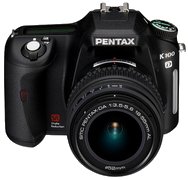 After much deliberation, I finally made my decision and got the Pentax K100D. There are two major reasons why I chose it over the Nikon D40.
The first reason is the feature set: it has just too many higher-end DSLR features to pass up. In fact, you could mistake it for a higher-end camera if not for the 6 megapixel resolution.
This approach of putting higher-end features to a lower-end camera also applies to its bigger brother, the Pentax K10D, which I almost considered. Unfortunately, though it is a bargain by itself, it was just too pricey for my intended use.
The second reason is I was turned off by the local Nikon distributor’s representative who was all impatient and arrogant when I made inquiries. They may have their reasons and they may be makings tons of money selling Nikons but they sure won’t be making it from yours truly.
I’ve been playing around with my K100D for the past few days and I must say I’m quite happy so far. It’s very intuitive: I figured out most of the functions without reading the manual. And, of course, it takes great pictures. They could be a lot better in terms of composition, lighting, etc but in terms of image capture it’s pretty much spot on. More here as I get to know the camera better.
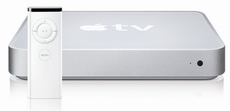 Okay so it’s just in the US right now, but the Apple TV announced by Apple last January is now out. The Apple TV is basically an interface between your computer and your TV. Movies and TV shows you download from iTunes to your PC are transferred via your network, even wirelessly, to the Apple TV. You can then play these movies and TV shows on your big-screen TV while sitting on your comfy sofa.
We’ve had such functionality for some time now. The MediaGate immediately comes to mind but I’m sure there are others out there. However, if there’s one thing Apple does very well, it is package everything essential into one cool package, make everything easy to use, and then tie everything up together. Plus of course there’s the Apple mystique. They did it with the personal computer (Mac), they did it with portable entertainment (iPod) and now it seems they’re going to do it for home entertainment.
I can see new TVs coming out with that white and silver theme now.
|
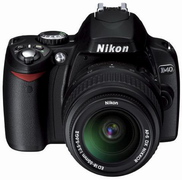 |
I’ve been planning to dabble in a bit more serious photography for some time now. Nothing so serious as to go for monster DSLRs with gazillions of pixels. Just enough to get to know the technical aspects. So the answer is one of those entry-level DSLRs that have been popping around all over lately. The choice has boiled down to the Pentax K100D and the Nikon D40. Both good entry-level DSLRs.
I’ve been comparing them for some time now and the way I see it, the K100D has higher-end DSLR features that the D40 does not: Shake Reduction (SR), dust removal, 11-point AF (D40 has 3-point AF), built-in AF motor, depth-of-field (DOF) preview, auto exposure bracketing, and top LCD status display. As a bonus, it uses widely available AA batteries. With 2500mAh and even 2700mAh rechargeable batteries becoming available, longevity should not be an issue.
On the other hand, the D40 has two things the K100D does not have: dedicated AF-assist lamp and large continuous shooting buffer. The D40 also is generally better in terms auto white balance (AWB), metering, noise reduction, and image processor.
However, in terms of picture quality, it’s a toss-up. From the sample shots I’ve seen, usually the K100D’s has better colors and the D40’s are sharper. But there are quite a lot of exceptions to this.
Tough choice.