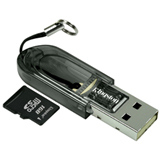
 When I recently got a microSD, one of the things I did was to research for a USB microSD reader. I found the really nice Greenhouse microSD Reader online and at Galleria but it was P450 each! I also found the Kingston USB microSD Reader online but doesn’t seem to be available at local stores.
Then this afternoon, I saw a clone version of it at CD-R King, purveyor of cheap (and sometimes unreliable) CDRs, DVDRs, and electronic gadgets. But I thought what the heck. How many ways can you go wrong with a card reader, anyway? And besides, it’s just P150. So I got one :D
Physically, the CD-R King reader is exactly the same as the Kingston. It’s not as small as the Greenhouse but it’s small enough at just about the size of the USB connector. It also has a protective plastic shell so you can just keep your microSD in the reader and you have a USB flash drive.
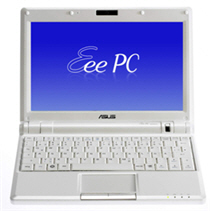 The Asus EEE PC 900 has been shown by Asus at CeBIT 2008. It’s got the same small and cute form factor as the originals but now has an 8.9″ screen, 1GB or RAM, and 12GB SSD. Those are exactly what I’ve been waiting for! Time to start saving up.
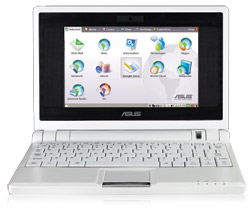 Yesterday, as I was heading out for lunch, I encountered Tessa at the elevator lobby. She was carrying this small black neoprene case that almost without a doubt contained an electronic gadget. From the dimensions, I concluded that it was an Asus Eee which I’ve heard and read quite a bit about. But to be sure, I asked her and she confirmed that it is indeed an Eee. We talked about it a bit but since lunch was waiting, I scheduled a visit with her for later in the afternoon. As soon as I got some free time, I went up to her office and played around with the Eee.
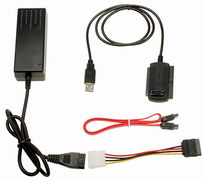 This one is one of those indispensable techie tools. It’s a 3-in-1 external drive adapter from large IDE, small IDE, and SATA interface to USB 2.0. This means that with only one kit, you can connect practically ANY disk-based storage device via high-speed USB 2.0 to your PC. That would be 5.25″ form-factor CD and DVD drives, 3.5″ desktop hard drives, and 2.5″ notebook hard drives. You can also connect both a SATA and an IDE device at the SAME time. And here’s the clincher: there’s no fancy shmancy casings. Only exposed wires and circuit boards. How geek cool is that?